

OpenAI API — Inference with your organization’s key
With this integration, the GPT calls SecureAI makes go to the OpenAI API with your organization’s own API key, instead of through SecureAI-managed providers. OpenAI bills your organization or project: the usage draws on your credits, your discounts, your budget and your rate limits. SecureAI stays in the path of every request: DLP, model policies, audit and signed receipts apply exactly as with any other provider.Not the same as OpenAI Platform. This page connects OpenAI as an inference provider (Admin → Integrations → AI providers) with a regular API key, which can only call models. The OpenAI Platform card in the Cloud category uses an Admin key to inventory projects, keys and usage, and never sends a prompt. They are independent: use either one, or both.
How it works
- You create an API key dedicated to SecureAI in the OpenAI platform and save it in SecureAI. It is stored encrypted and never shown again.
- On save, SecureAI uses the key to read the list of models it can call (
GET /v1/models, chat models only) and matches each GPT model of SecureAI’s catalog to the OpenAI id that serves it. - On every chat turn or task with a GPT model, SecureAI applies DLP and the model policy, signs the request and sends it to OpenAI’s Chat Completions API through its SMLTP gateway.
- The response comes back through the gateway, which inspects and redacts it (streaming included) before it reaches the user, and issues the signed receipt.
What runs on your key and what does not
How many inference providers you can use
The OpenAI API counts as one more inference provider, like Google Vertex AI, Azure AI Foundry, Amazon Bedrock and the Anthropic API:
Each model family can be routed to one provider only. If GPT already runs on Azure AI Foundry or Amazon Bedrock, remove it there first: SecureAI refuses an overlapping configuration and says which family collides.
Prerequisites
- An OpenAI organization with active billing (or a project with a budget).
- Permission to create API keys in the OpenAI platform (API keys).
- Admin permission on SecureAI’s Integrations section.
- Your organization’s SMLTP model policy must allow at least one GPT model your key can call (AI Gateway → Policies). SecureAI applies that policy to these calls too.
Step 1. Create the key in the OpenAI platform
- In the OpenAI platform, go to API keys and click Create new secret key.
- Give it a recognizable name (for example
SecureAI). We recommend a project key: it limits the key to one project, with its budget, its limits and its model access. - Copy the key (it starts with
sk-). OpenAI shows it only once.
Step 2. Connect the key in SecureAI
-
Go to Admin → Integrations → AI providers and open OpenAI API — Your organization’s key.
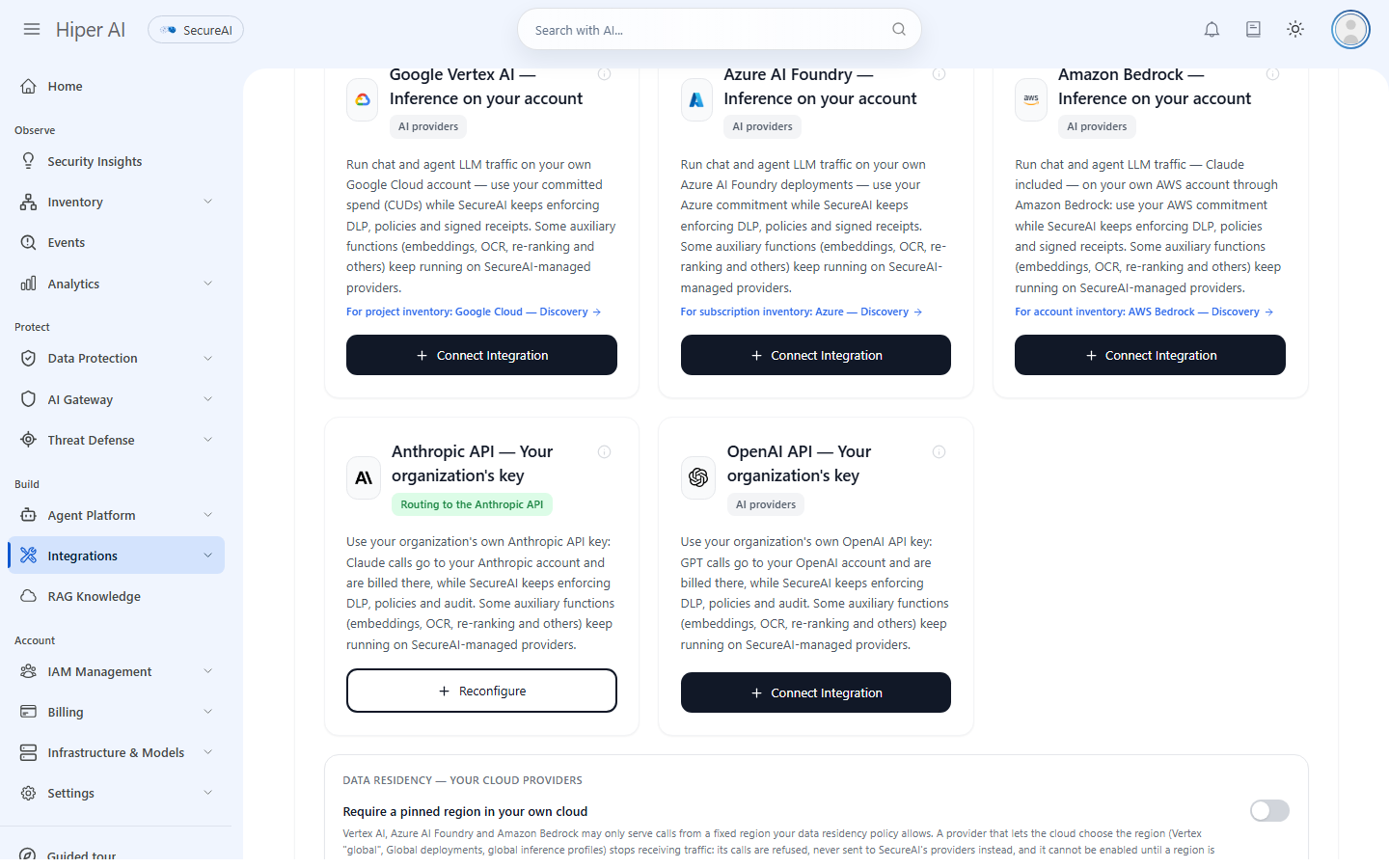
-
Fill in:
- Click Save.
- The key field clears and shows Key saved (…xxxx): only the last 4 characters stay visible. The key is never sent back to the browser. To change it, type a new one; an empty field keeps the stored key.
- Models your key can call lists the chat models of your account. Use Refresh when OpenAI opens new models to your key or project.
- No traffic is routed yet: the integration is saved switched off so you can test it first. The card shows Configured · not routing to the OpenAI API.
Step 3. Choose what runs on your key
What runs on the OpenAI API has two modes:- Only these model families (the default, with OpenAI selected): GPT models run on your key; everything else stays on SecureAI’s providers or another connected cloud.
- Remap everything to the OpenAI API: every LLM call runs on your key. Models OpenAI does not serve (Claude, Gemini…) are answered by the default OpenAI models.
openai/gpt-5.2 → gpt-5.2) or, when your key only has the dated version, that one (gpt-4.1-2025-04-14). A model your key does not have is hidden from users (or goes to SecureAI if you allowed fallback).
Default OpenAI models (pick them from your key’s list):
In Model → OpenAI id overrides you can send a SecureAI catalog model to an exact OpenAI id, a fine-tuned model included (
ft:gpt-4.1-mini:…). Overrides win over automatic matching.
Two more options:
Models of your key the catalog does not list
Chat models your key can call that SecureAI’s catalog does not have appear under the Offer the models of your OpenAI API that SecureAI does not list switch, when your deployment offers models of your own cloud. Untick the ones you do not want to offer, or turn the switch off. For users to pick them in the chat (the Your OpenAI API section of the model selector), add them to the SMLTP model policy in AI Gateway → Policies, where they are listed in the same section. They run only on your key, never on SecureAI’s providers, even with fallback allowed.Step 4. Test and switch on
- Click Test connection. It sends a minimal (one-token) request to each default model through the same path real traffic will take — gateway, model policy and receipts included. With no default models yet, it probes the cheapest GPT model your key can call that your SMLTP model policy allows. The test is billed to your OpenAI account (a fraction of a cent).
- Check the Routing preview: for each catalog model it shows whether Your OpenAI API key will serve it (and with which id), another connected cloud, or SecureAI, and which ones will be hidden from users.
- When the test passes, turn on Route traffic to the OpenAI API and click Save. The switch does not stick until you save.
- The card turns green: Routing to the OpenAI API.
Data residency
SecureAI cannot pin the region where OpenAI processes a call. So if your organization turns on Require a pinned region in your own cloud (below the provider cards in Admin → Integrations → AI providers):- Routing to the OpenAI API cannot be enabled.
- If it was already enabled, its calls are refused — never sent to SecureAI’s providers instead.
What is billed, and to whom
- OpenAI bills the usage to your organization or project, with your credits and discounts. Rate limits and budget are those of your OpenAI organization or project.
- SecureAI shows the cost of those turns as a list-price estimate for analytics only; the real figure may differ.
- These turns do not count against the seats’ spend cap, unless you turn on Apply each seat’s spend cap to turns billed to your key.
Security and compliance
- The key is write-only. It is stored encrypted and never returned to the browser, not even to an admin: only its last 4 characters are shown. It never appears in the activity log.
- The path stays protected. Every call goes through SecureAI’s SMLTP gateway: model policy, DLP on the prompt and on the response (streaming included), a per-request authorization token and a verifiable signed receipt. The gateway forwards your key to OpenAI and holds none of its own.
- Fail closed. If the key cannot be read, OpenAI rejects it or a model is not available to your key, the request is refused; it is not sent to another provider unless you allowed fallback.
- Kept apart from SecureAI’s keys. Calls paid by your key use a lane of their own, separate from the one SecureAI uses with its own account.
- Audit. Saving, testing or disconnecting the integration is recorded in the activity log, never with the key.
Disconnect and revoke
Disconnect (panel footer) deletes the configuration and the stored key. From then on, all the traffic your key served returns to SecureAI-managed providers. You can also just turn off Route traffic to the OpenAI API to pause routing and keep the connection. To revoke SecureAI’s access on OpenAI’s side, delete the key in the OpenAI platform (API keys).Troubleshooting
These are the reasons Test connection shows:
Errors users may see in the chat:
When a call fails for a reason only an admin can fix (a revoked key, quota exhausted, a model not available), SecureAI notifies the admins by email, on the integration card and in the notification bell.
Current limitations
- No pinned data residency (see above).
- gpt‑oss does not run on your key: OpenAI does not host those models.
- Embeddings, re-ranking, OCR, the admin assistant, image generation and realtime voice stay on SecureAI-managed providers.
Related
- Anthropic API — Inference with your organization’s key
- Azure AI Foundry — Inference on your account: GPT on your Azure resource, with data residency.
- OpenAI Platform: inventory of OpenAI projects, keys and usage.
- Cloud AI providers overview
- Signed receipts